The King’s Return: 5 Impactful Truths Behind BTS’s Historic Gwanghwamun Takeover
1. Introduction: The City That Never Sleeps (For a Reason)
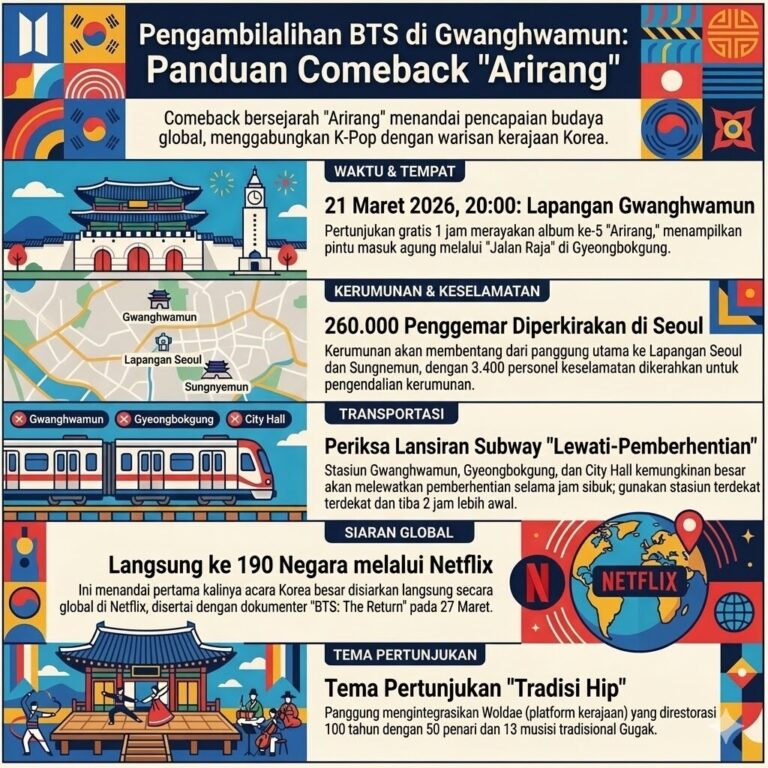
As the March 21, 2026, comeback date approaches, a palpable electric charge has settled over the Seoul skyline. The “BTS THE COMEBACK LIVE: ARIRANG” event is more than a concert; it is a seismic urban phenomenon projected to draw between 200,000 and 300,000 attendees to the nation’s symbolic core. This historic takeover represents a reclamation of space where the 600-year-old stones of Gyeongbokgung Palace meet the hyper-modern energy of 21st-century global icons.
2. Takeaway 1: A Netflix Global First (The World is Watching)
In a definitive display of South Korea’s soft power, the “ARIRANG” performance will be broadcast live via Netflix to 190 countries simultaneously. This marks a historic “Netflix First,” as it is the first major Korean cultural event to be live-streamed globally on the platform, turning a local square into a site of digital pilgrimage. The momentum continues beyond the live event with the scheduled March 27 release of the documentary BTS: THE RETURN, which chronicles the high-stakes production of this comeback.
3. Takeaway 2: Walking the “King’s Road”
The performance is a masterclass in “Hip-Tradition,” utilizing the three primary gates of Gyeongbokgung—Geunjeongmun, Heungryemun, and Gwanghwamun—as a sprawling, multi-layered stage. The production features a massive media facade projected onto the palace walls, accompanied by 50 dancers and 13 members of the Arirang Gugak Band. Central to the narrative is the restored “Woldae,” the elevated platform where Joseon kings once communicated with their subjects, which serves as the physical bridge for BTS’s return.
“The road from Geunjeongmun to Gwanghwamun is the ‘King’s Road,’ a symbol of the Joseon Dynasty’s authority and a place of communication with the people.”
4. Takeaway 3: Suga’s “Heart of Gold” Birthday Legacy
Member Suga (Min Yoon-gi) has elevated the concept of “Idol Diplomacy” following his 33rd birthday on March 9. His record-breaking 5 billion Won ($3.6 million) donation to Severance Children’s Hospital established the “Min Yoongi Treatment Center” for youth with autism spectrum disorder (ASD). Far from a passive contribution, Suga co-developed the “MIND” therapy program, a music-based clinical initiative designed to support emotional expression and social interaction.
5. Takeaway 4: The Heritage vs. Hype Dilemma
Hosting hundreds of thousands at a National Heritage site has prompted a “Conditional Approval” from the Cultural Heritage Administration, reflecting deep-seated fears of vandalism. Memories of the 2008 candlelight protest damage and 2023 incidents of graffiti and public misconduct have led to the most stringent safety protocols in Seoul’s history. To safeguard the palace and its crowds, the city has deployed a massive logistical grid:
- Security: 3,400 specialized response personnel stationed throughout the Gwanghwamun-to-Sungnyemun corridor.
- Infrastructure: 894 temporary toilets strategically placed to prevent damage to historic grounds.
- Transit: A mandatory “skip-stop” policy for Gwanghwamun, Gyeongbokgung, and City Hall subway stations during peak hours.
- Broadcast: Use of Sungnyemun on March 20 for preliminary content transmission to disperse the initial arrival of fans.
6. Takeaway 5: Survival Tips for the “Seoul Adventurer”
For those navigating this era of “ARIRANG,” the city offers both traps and treasures. The Seoul Metropolitan Police have intensified crackdowns on hotel price gouging, noting that 20% of surveyed local accommodations still fail to display legal price labels. To escape the 300,000-person crush, savvy travelers should retreat to the “Jeongdong-gil” walk, home to the San Damiano book cafe and the famed coffee at Lusso Lab. Families seeking the Seoul Craft Museum’s Children’s Museum must act with precision, as online reservations are required exactly 14 days in advance.
7. Conclusion: A New Era of Cultural Synthesis
This milestone confirms that Korean tradition is evolving from a static history into a vibrant, global currency. By performing at the intersection of royal Joseon architecture and the digital future of Netflix, BTS has turned Gwanghwamun into a living testament of cultural synthesis.
“Tradition is no longer a ‘stuffed relic’ but has become the most ‘hip’ cultural code for the global MZ generation.”
As the purple lights reflect off the 600-year-old stone walls, a final question remains: Can ancient walls truly withstand the energy of the modern world, or does pop culture give these stones a new reason to stand?