1. Korea’s Tourism Grand Leap
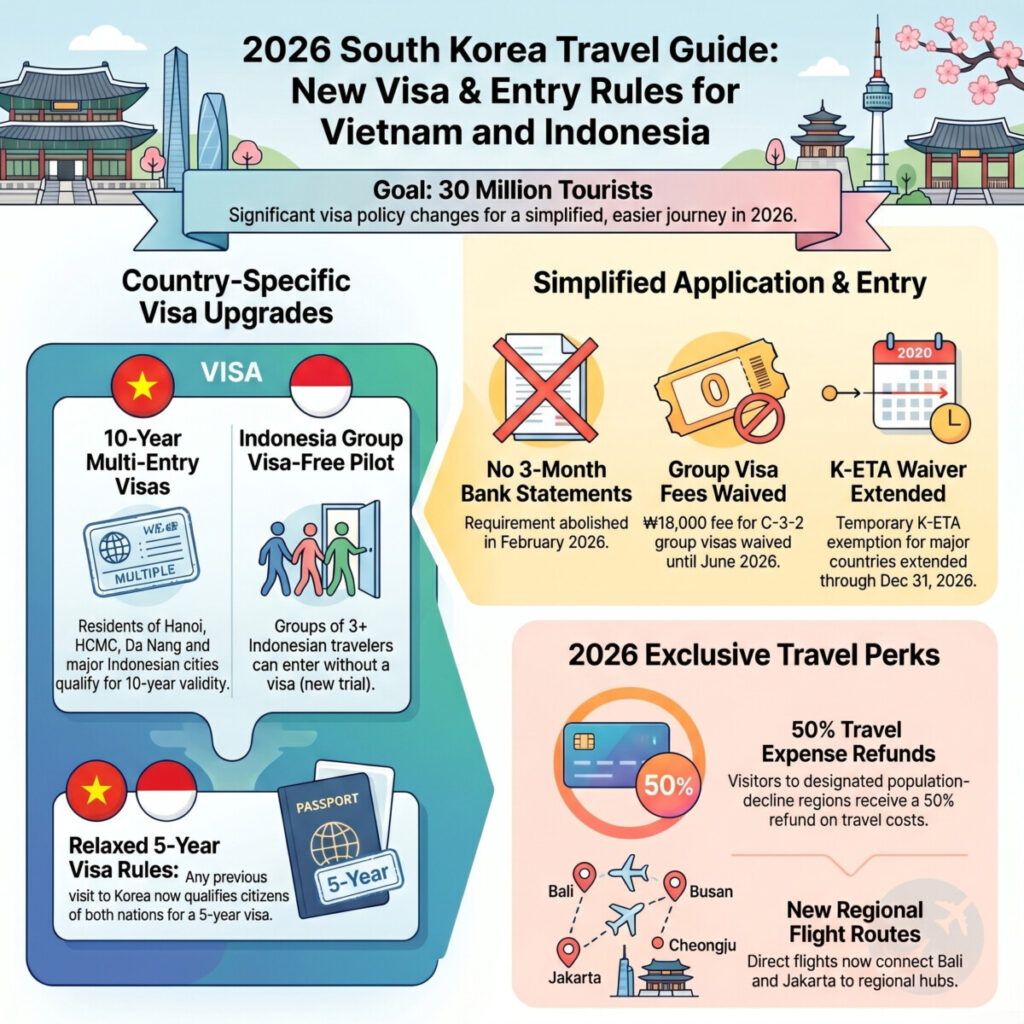
The Republic of Korea has officially designated tourism as its “second semiconductor industry,” a strategic pivot intended to drive national growth through international mobility. With a goal of welcoming 30 million tourists by 2029, the government has accelerated its policy reforms to make 2026 the most accessible year in history for travelers. This push serves as the cornerstone for the upcoming “Visit Korea Year 2027–2029” campaign.
As an immigration specialist, I am seeing a shift toward unprecedented administrative ease. While these changes benefit global travelers, 2026 features localized breakthroughs specifically for visitors from Vietnam and Indonesia.
2. Specialized Visa Benefits for Vietnam and Indonesia: A Comparative Look
In April 2026, the Ministry of Justice (MOJ) introduced targeted enhancements for Southeast Asian neighbors, prioritizing “frequent traveler” status and regional connectivity.
| Feature | Vietnam (Focus: Metropolitan Access) | Indonesia (Focus: Group & Regional Connectivity) |
| Long-Term Mobility | 10-Year Multiple-Entry (C-3-9): Residents of Hanoi, Ho Chi Minh City, and Da Nang are now eligible for a decade of travel. | Expanded 10-Year Access: Eligibility now includes residents of major metropolitan cities and frequent visitors. |
| Previous Visit Record | Abolished Restriction: The 5-year multiple-entry visa no longer requires a pre-2016 travel record. | Trial Visa-Free Entry: Pilot program for group tourists (3+ travelers) now in effect. |
| Regional Strategy | Focus on metropolitan household registration (Hộ khẩu). | Direct Flight Synthesis: Groups of 3+ can leverage new direct routes from Bali/Jakarta to Busan (Gimhae) and Cheongju, bypassing Seoul entirely. |
Consultant Insight: The pilot visa-free entry for Indonesian groups is a strategic “fast-lane.” By utilizing the new direct flight routes to regional airports like Cheongju, groups can avoid the congestion of Incheon while enjoying simplified entry protocols.
3. The “Paperwork Revolution” (Effective February 20, 2026)
Beginning February 20, 2026, the administrative burden for ROK visa applications underwent a massive simplification. This “Paperwork Revolution” targets the most common pain points for applicants:
- Bank Statement Abolition: The mandatory 3-month bank statement requirement has been removed, significantly lowering the barrier for financial proof.
- The “Explanation Letter” Waiver: Previously required for missing landline numbers or electronic signatures on employment documents, this letter is now waived if the applicant provides a reachable mobile number or email.
- Student Document Relief: Students can now submit a simple copy of their student ID in place of formal school certificates, which were historically difficult to procure.
- Family & Office Efficiency: For multiple applicants (families or colleagues), only one copy of common documents—such as invitation letters or family certificates—is required for the entire group.
- Jakarta Processing: The Korea Visa Application Center (KVAC) in Jakarta remains the primary hub for managing these streamlined requirements with improved technical efficiency.
4. 2026 Visa Fees and Financial Incentives
While the government has simplified the process, travelers must be aware of the “No Refund” policy: visa fees are non-refundable regardless of whether the visa is granted or rejected.
2026 Korean Visa Fee Schedule
| Visa Type | Standard Fee (USD) | 2026 Special Waivers & Incentives |
| Short-Term Single Entry | $40 | N/A |
| Multiple Entry (1 Year) | $80 | N/A |
| Multiple Entry (5–10 Year) | $120 | Focus of 2026 expansion for VN/ID/CN |
| Group Visa (C-3-2) | $20 | Waiver of $12.45 (KRW 18,000) extended for 6 countries* |
*The group visa fee waiver (covering Vietnam, Indonesia, China, India, Philippines, and Cambodia) is strictly valid through June 30, 2026.
5. Modernized Entry Systems: K-ETA, Q-CODE, and Automated Gates
Digital transformation at Incheon and regional airports has reached a peak for the 2026 season.
- K-ETA Waiver & Strategy: While the temporary K-ETA waiver for select countries is extended through December 31, 2026, travelers have a strategic choice. You may still choose to apply for a K-ETA (and pay the fee) to receive the benefit of skipping the paper arrival card, allowing for a faster exit from the terminal.
- Automated Immigration Expansion: Effective March 16, 2026, the eligibility for automated immigration gates expanded from 18 to 42 nationalities, including Canada and all European Union (EU) member states.
- Digital Health Reporting: The Q-CODE (Electronic Quarantine Inspection) and e-Arrival Card are now the expected standards for entry. Completing these online before departure is the most effective way to reduce processing time at the border.
6. Exclusive 2026 Tourism Campaigns: “K-Content” and Beyond
Beyond the capital, 2026 offers significant financial incentives to explore Korea’s hidden gems.
- “Half-Price Travel” (Regional Love Vacation Support): Starting April 2026, visitors to “depopulating regions” (including 27 designated areas on the South Coast) can receive a 50% refund on expenses, capped at 100,000 won per person.
- Foreigner-Only Tourism Pass: Launching in H2 2026, this pilot pass integrates transportation (KTX, subways, buses) with attraction discounts into a single digital interface.
- Korea Grand Sale 2026 (Dec 17, 2025 – Feb 22, 2026): This 68-day festival features the “Play Truck” (a mobile center for coupons and K-shopping) and the “Play Lounge” in Bukchon. The festival is organized around 5 Major K-Content Themes:
- K-Gourmet: Hands-on cooking for bibimbap and K-street food.
- K-Exciting: K-Pop dance classes and music show tapings.
- K-Stylish: Professional K-beauty and hair styling seminars.
- K-Healing: Traditional medicine (Hanbang) and wellness retreats.
- K-Inspired: Architecture tours and musical theater experiences.
7. Conclusion and Essential Resources
With the removal of bank statement requirements, the expansion of 10-year visas, and a “Paperwork Revolution” that accommodates the modern digital traveler, 2026 stands as the easiest year to enter the Republic of Korea. Whether you are a group traveler from Indonesia flying directly to Busan or a metropolitan resident of Vietnam securing a decade-long visa, the barriers have never been lower.
Pro-Tips for 2026 Travelers:
- Check the Portal: Always verify localized requirements via the Korea Visa Portal (visa.go.kr) or Hi Korea (hikorea.go.kr) before booking non-refundable flights.
- Plan Ahead: Despite the simplifications, we recommend applying 3 to 6 months before your trip to ensure your specific visa type (e.g., C-3-9) is processed in time for the high season.
Korea is ready to welcome you with open arms. We look forward to seeing you in 2026!