Beyond the Skyline: The Ultimate Guide to Hiking Inwangsan Mountain
Where can you find a centuries-old fortress wall snaking over rugged granite ridges, all while overlooking the glittering high-rises of a 21st-century metropolis?
Inwangsan Mountain offers the most iconic urban trekking experience in Seoul. For foreign residents and travelers, it is a must-visit destination that perfectly balances accessibility with breathtaking scenery. As a curator of Seoul’s outdoor spaces, I consider Inwangsan the “people’s mountain”—it provides a unique “castle-like” atmosphere created by the Hanyangdoseong (Seoul City Wall) that bridges the Joseon-era past with a high-octane modern skyline.
Why Inwangsan? Location, Features, and History
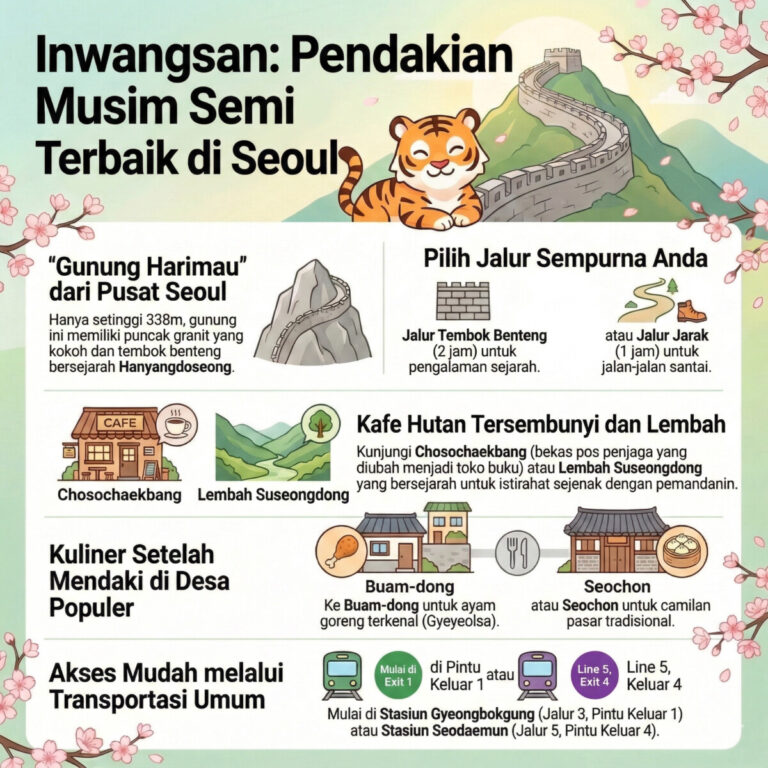
Inwangsan is one of the four “Inner Mountains” (along with Bukaksan, Namsan, and Naksan) that protected the Joseon capital, Hanyang. The mountain is defined by its massive granite rock formations and steep ridges. In 1396, the Hanyangdoseong (Seoul City Wall) was constructed along these slopes to fortify the city, and the different stone shapes along the wall still tell the story of various construction eras.
The mountain also holds a “secret” historical charm. Following the “1.21 Incident” in 1968—an attempted raid on the Blue House by North Korean infiltrators—large sections were restricted for decades. Today, the area is fully open, allowing hikers to spot military relics like old bunkers (벙커) and the famous “1.21 Incident Pine Tree,” which still bears the scars of the skirmish.
Pro-Navigation Tip: Keep an eye out for the Golden Tiger Statue at the three-way intersection near Sajik Park. It’s a vital landmark for finding the main trailhead and a nod to the tigers that historically roamed these peaks.
Choosing Your Path: Major Hiking Courses
Inwangsan offers variety, from technical climbs over granite ridges to barrier-free strolls. Be prepared for the characteristic steep stone stairs (가파른 돌계단) found on the higher sections.
| Course Name | Distance | Estimated Time | Top Highlight |
| Hanyangdoseong (City Wall) Course | 4.1 km | ~2h 10m | The dramatic climb along the restored fortress wall to the summit. |
| Forest Trail (Suseong-dong Valley) | 2.9 km | ~1h 30m | Lush greenery and the “must-see” Gaon-dari (Cloud Bridge). |
| Jarak-gil (Accessible) Course | 2.7 km | ~1h 10m | Barrier-free wooden decks ideal for night walks and casual strolls. |
The View from the Top: Peaks and Landmarks
As you ascend the granite ridges, the trail reveals several iconic landmarks:
- Beombawi (Tiger Rock): This massive formation is the crown jewel for photographers. It offers the “classic” Seoul view, framing Namsan Tower and the dense city lights perfectly.
- The Summit: Marked by a wooden post at 338 meters, the peak offers a 360-degree panorama of Gyeongbokgung Palace, the Blue House (Cheongwa-dae), and the neighboring Bukaksan peaks.
- Gichabawi (Train Rock): A long, flat rock formation that offers a unique ridge-walking experience leading away from the summit.
The Magic of Night Hiking
Inwangsan is Seoul’s premier night-hiking destination. The City Wall is illuminated after sunset, creating a golden ribbon against the mountain.
- Safety Tip: The fortress wall lights typically turn off at 10:00 PM. While the main wall is lit, some initial stair sections can be dark; bring a phone light or headlamp to ensure a safe descent.
Pro-Tips for Foreigners: The Seoul Hiking Tourism Center
If you didn’t bring gear, don’t worry. The Seoul Hiking Tourism Center (Bukaksan Branch), located at Samcheong-ro 88, is a game-changer for international visitors.
- Essential Gear Rental: Foreign tourists can rent high-quality hiking boots, clothes, trekking poles, and backpacks for a small fee.
- Requirements: You must bring a valid ID (Passport or Alien Registration Card) to utilize rental services.
- Hanok-Style Lounge: One of the center’s best features is its beautiful Hanok-style rest area—a perfect spot to relax in a traditional atmosphere before or after your hike.
- Operating Hours: The center is open 09:00–18:00, but is closed every Tuesday.
- Reservations: Book your gear in advance at www.seoulhiking.or.kr.
Post-Hike Rewards: Where to Eat and What to See
After your descent, the neighborhoods of Buam-dong and Seochon offer excellent cultural rewards.
- Cultural Spots: Descend toward Changi-mun to visit the Yun Dong-ju Literature Museum. From there, head to “The Forest Choso Bookshelf,” a trendy cafe and bookstore converted from an old military security post.
- Nearby Eats: Visit Cheonjin Poja near the Changi-mun intersection. It is legendary among hikers for its traditional dumplings and hearty Hontun-tang (wonton soup).
- Seochon Village: Descending toward the south brings you to Seochon (West Village), a maze of traditional alleys filled with modern galleries and “hidden gem” restaurants.
Logistics: How to Get There
Inwangsan is remarkably central, accessible via Gyeongbokgung Station (Subway Line 3):
- To Walk to the Trailhead: Use Exit 1. Walk straight for about 300m toward Sajik Park and follow the signs for the “Inwangsan Mountain Restroom” or the Tiger Statue.
- To Take the Bus: Use Exit 3 to catch blue bus 1711 or green bus 7016. These will take you toward the Changi-mun or Sangmyung University area if you prefer to start your hike from the northern side.
Conclusion
Hiking Inwangsan is more than just a workout; it is a journey through Korea’s defensive history and a front-row seat to its urban evolution. Whether you’re scaling the granite stairs or enjoying a quiet moment at Suseong-dong Valley, you’re participating in a beloved Seoul tradition. Please remember to “take only photos and leave only footprints” to preserve this historical treasure.
Which trail will you conquer first?
#Inwangsan #SeoulHiking #VisitSeoul #Hanyangdoseong #SeoulCityWall #UrbanTrekking #KoreaTravel